How to Manage Your Construction Contract Successfully
A practical guide to construction contract administration — the six-step cycle from RFI to payment certificate, notice discipline, variations, extensions of time and claims, mapped against FIDIC 2017 and NZS3910:2013.
Project names, parties and commercially sensitive figures referenced in this article have been anonymised or generalised. Examples reflect real situations encountered across multiple projects; they are not attributed to any specific client, contractor or contract.
Walk into any monthly project meeting and the conversation follows the same script. The commercial team reports the account. The site team reports what actually happened. The client asks whether the entitlement is real. Then everyone discovers that nobody wrote the instruction down at the time, and the argument becomes about memory instead of the contract.
I've seen a $38,000 variation written off because a fire-rated wall was moved on a verbal instruction that never reached a referenced document. I've also seen an eleven-week weather delay survive a late notice, purely because the site manager had signed a diary entry every day for eleven weeks. Same pressures. Different discipline.
This article sets out how to manage a construction contract successfully from mobilisation to final account — not as a legal exercise, but as a working system you can run on a live project this month.
A note on clause numbers: the references below reflect the standard FIDIC 2017 Red Book and NZS3910:2013 base forms. Particular and Special Conditions amend clauses constantly. Always verify against your own contract, and treat this as practical guidance rather than legal advice.
Why Contract Administration Fails on Construction Projects
Before the process, the honest diagnosis. Contract administration usually fails for four reasons:
- It starts too late. The register gets built after the first crisis, not in the first 30 days — so the crisis is reconstructed rather than recorded.
- Nobody owns the clock. One person often holds three roles on a small project, which scales fine. What doesn't scale is nobody being told which responsibilities are theirs, so each assumes someone else is watching the notice period.
- Change is recorded in three places. RFIs in one spreadsheet, variations in another, EOTs in a third, reconciled quarterly at best.
- The instruction and the value are separated. The instruction gets confirmed in writing; the price gets left "until things calm down." By final account nobody can reconstruct which rate basis was intended.
Every one of those is a systems problem, not a knowledge problem — which is why the fix is a system.
The Six-Step Cycle, Applied to Construction
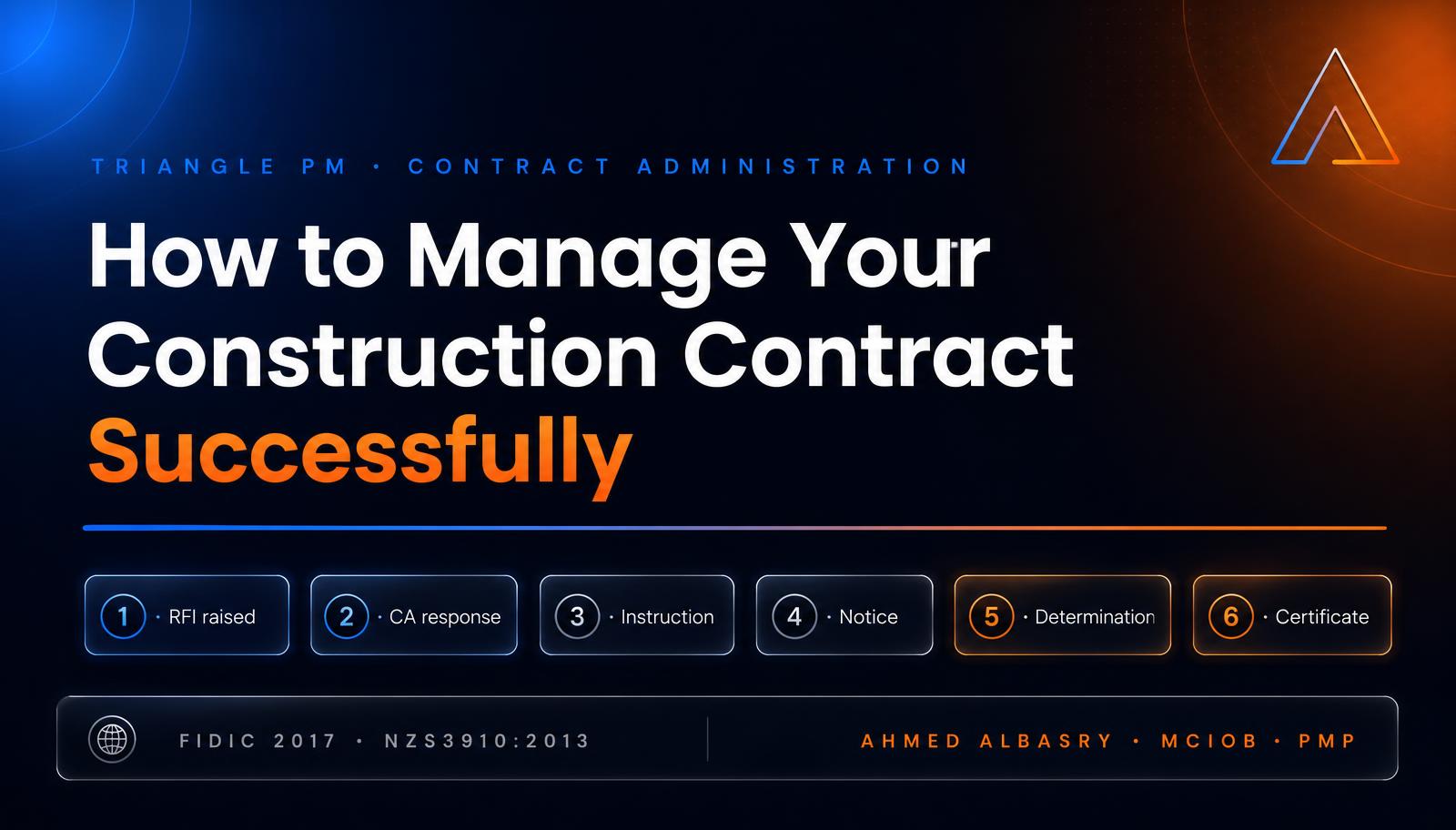
Every RFI, variation, delay event and claim moves through the same cycle. Learn it once and the discipline becomes navigable.
1. RFI or Site Query Raised
Most slow RFI responses are not the Engineer being difficult — they are the Engineer being unable to answer the question as written.
A strong RFI references the exact documents in conflict (Drawing A-204 Rev D vs Specification 03300 §4.2), proposes an answer, and states the date a response is needed by. An RFI that proposes a solution gets answered faster, because "confirmed" becomes a valid one-word response. Give it a permanent reference the day it's raised, and never renumber. For the full workflow, see How to Manage the RFI in Your Construction Project.
2. Engineer or CA Responds
Clarify, instruct, or refer for pricing. Then check one thing: did the answer change scope, cost or time? If it did, it's a variation trigger even if nobody called it one. Flag it that day rather than letting change slip through as "just an RFI answer."
Neither base form fixes an RFI response time — your communications protocol should.
3. Instruction or Variation Issued
A variation is defined by whether it was instructed, not by whether anyone meant it as one. "Can you just move that wall while you're there" is a variation instruction if it comes from someone with authority to give one.
The single most valuable habit in contract administration costs one email:
"Confirming your instruction of today to relocate Wall W-14 by 1.2m — please countersign or advise if this is not agreed."
Then price it. Confirming the instruction protects the fact; pricing it protects the number. Both forms allow pricing in advance — FIDIC Cl. 13.3.1 actively encourages it — and an agreed value before work starts removes almost all final account risk on that item.
Follow the valuation hierarchy in order. Neither form lets you pick a favourite:
| Order | FIDIC 2017 (Cl. 12 via Cl. 13) | NZS3910:2013 (Cl. 9.3) |
|---|---|---|
| 1st | Contract rates, similar character and conditions | Cl. 9.3.5 — Contract rates where applicable |
| 2nd | Contract rates adjusted pro-rata | Cl. 9.3.6 — Derived rates |
| 3rd | A fair rate where no Contract rate applies | Cl. 9.3.7 — Net Cost |
Defaulting to Net Cost because it's easiest to record is one of the most common commercial mistakes on site. It's the last resort in both forms, not the first choice.
4. Notice and Substantiation
Both forms build in short, strict windows for notice. Treat every one as a deadline for a letter, not a deadline for a decision. You can refine the number later; you cannot recover a missed notice.
Three things have to be right: in writing per the communications clause, sent to the nominated address in the Contract Data, with provable service. One Contractor's EOT notice went to the Engineer's site representative, who had never been formally nominated as the notice address — it was later disputed as invalid on service grounds alone, regardless of merit.
For an extension of time, name the specific listed ground. "This is an EOT event under Cl. 8.5(b)" signals a considered claim; "we're behind because of your design team" signals a complaint. The detail is covered in Managing Extension of Time (EOT) Claims & Variation Orders.
5. Determination and Record
Expect determinations to come back lower than claimed, and understand why that's normal: a Contractor claiming 21 days for a services clash was granted 9, because the windows analysis showed 12 days of float before it was resolved. The entitlement is what the programme evidence supports.
You rarely need a forensic planner. Three methods cover most claims — as-planned vs as-built for single events, windows analysis for overlapping ones, time impact analysis for complex ones. All three test the same thing: did the event push out an activity on the critical path? A delay to an activity with float may carry no entitlement at all, however disruptive it felt.
Watch for the common but incorrect concurrency position: "there was some Contractor delay in this period, so the whole EOT is refused." Concurrency is assessed activity by activity — a Contractor delay on a non-critical activity does not defeat an EOT event on the critical path.
6. Payment or EOT Certificate
Determined value converts into a certificate. Here the two forms run in opposite directions, and the difference has teeth.
FIDIC certifies from the Engineer outward: the Contractor submits a Statement, the Engineer certifies within 28 days (Cl. 14.6). NZS3910 — and the New Zealand Construction Contracts Act more broadly — works the other way: the Contractor's Payment Claim is deemed correct unless the Engineer responds with a Payment Schedule in time. A missed response can make the full claimed amount payable regardless of whether the claim was accurate. Calendar every response-due date the day the claim arrives.
Then close the loop: every determined item goes back into the master register, which is what makes step 1 of the next cycle fast. On an active site this loop runs ten times a week across different work fronts.
Know Which Clock You're On
Both forms solve the same problem — who decides, and by when — but route it through different people and different clocks.
| Topic | FIDIC 2017 (Red Book) | NZS3910:2013 |
|---|---|---|
| Contract administrator | The Engineer (Cl. 3) — appointed by, but required to act neutrally under, the Employer | The Engineer (Cl. 6) — same dual role; limited delegation to the Engineer's Representative |
| Variations | Clause 13 — Engineer instructs | Clause 9 — valuation sequence at 9.3.1–9.3.7 |
| Extension of time | Clause 8.5, against listed causes | Clause 10, including Principal default as an express ground |
| Notice of claim | Clause 20.1 — 28 days, a condition precedent | No single hard time-bar; notice "as soon as practicable" |
| Payment | Cl. 14.6 Interim; 14.13 Final Payment Certificate | Clause 12 — Payment Claim / Payment Schedule cycle |
| Dispute resolution | Clause 21 — DAAB, then arbitration | Clause 13 — Engineer's Formal Decision, then negotiation, mediation, arbitration |
FIDIC's 20.1 notice is a strict condition precedent in most jurisdictions — miss it and the entitlement can be lost outright. NZS3910 is more forgiving on timing but still requires the Engineer to be notified before the cost or delay is locked in. Know which clock you're on before you rely on "we always do it this way."
The Four Documents That Govern Your Day
"The contract" is not the signed agreement plus the drawings. Both forms define it as the whole stack — drawings, specifications, schedules, addenda, the accepted programme, and whatever the precedence clause names. In daily practice, four documents do the work:
| Document | What it governs | Who owns it |
|---|---|---|
| Signed contract and conditions | Risk allocation, notice periods, the Engineer's powers, valuation rules | Fixed at signing |
| Programme (baseline and current) | What "on time" means; the reference point for every EOT | Contractor prepares, Engineer accepts; frozen at baseline |
| Schedule of prices / cost plan | The valuation basis for variations and payment claims | Fixed at signing |
| Master register | Every RFI, instruction, variation, EOT and claim | Contract administrator — updated daily |
Three of those are meant to stay still — they're the yardsticks. The master register is the only one that should change every day. If you find yourself casually editing the baseline programme or the schedule of prices, check whether that change needs a formal variation first.
One more distinction: a shop drawing cannot override a contract drawing. Shop drawings are prepared to comply with the contract documents, not to vary them. A mismatch is an RFI, not a licence to build to the shop drawing.
Sample Contract Administration Master Register
One row per instruction, whatever type it is. Build it once in Excel or your document platform, and every workflow above plugs straight into it.
| Ref | Type | Description | Raised | Due | Status | $ Impact | Time |
|---|---|---|---|---|---|---|---|
| RFI-014 | RFI | Transfer beam TB-2 vs services riser clash, Grid D/4 | 08 Feb | 15 Feb | 🟢 Closed | — | — |
| VO-09 | Variation | Relocate TB-2 by 400mm; revise riser (ref RFI-014–018) | 24 Feb | 10 Mar | 🟢 Agreed | $58,900 | 0 |
| EOT-04 | EOT | Contaminated fill, attenuation tank excavation | 06 Apr | 20 Apr | 🟢 Determined | — | 9 days |
| CL-01 | Claim | Productivity loss, M&E trades — riser and remediation | 12 Jun | 30 Jun | 🟠 Pending | $59,300 | — |
| PC-05 | Payment | Interim claim incl. VO-09 and EOT preliminaries | 01 Jul | 13 Jul | 🔴 Overdue | $742,000 | — |
Two rules make it work: permanent references from day one, and status set by RAG against the due date — not against how comfortable the conversation feels. Then reconcile variation values against the original contract sum at every payment cycle. A widening, unexplained gap between "instructed" and "agreed" is a final account dispute forming in real time, usually months before anyone calls it one.
Common Mistakes Construction Managers Make
| Mistake | Do this instead |
|---|---|
| Accepting verbal instructions without written confirmation | Send a same-day confirmation email naming the clause |
| Waiting for the monthly meeting to raise a claim | Notify the moment the cause is known; refine the value later |
| Running RFIs, VOs and EOTs in three spreadsheets | One master register, one numbering system |
| Confirming an instruction but never proposing a value | Include a proposed value, or a valuation basis, in the same email |
| Defaulting to Net Cost because it's easiest to record | Check for a reasonable Contract rate first |
| Treating a scope-changing RFI answer as "just clarification" | Route it into the variation workflow the day it arrives |
| Presenting a claim as a single total cost gap | Break it into individually evidenced cause-effect-quantum chains |
| Writing up the site diary at the end of the week | Daily entries, signed — a weekly write-up reads as reconstruction |
| Sending notices to whoever replies fastest | Use the nominated address, confirmed at contract start |
| Reopening agreed variations at final account | The final account should reconcile, not renegotiate |
Why Claims Fail — and How Records Prevent It
A claim succeeds or fails on whether it proves a chain: cause, effect, quantum — each with its own evidence. Don't let one strong piece carry the whole thing. The effect needs programme analysis and site records; the quantum needs rates, invoices and timesheets.
This is why global claims fail:
Weak: "Forty variations and delays caused this project to cost $400k more than tendered."
Strong: "Variations VO-04, VO-11 and VO-19 required 340 additional labour hours at agreed rates, evidenced by timesheets cross-referenced to each instruction."
The first relies on the size of the gap as proof of causation, and invites the obvious defence: some of that could be your own inefficiency. One Contractor's $180,000 "cumulative disruption" claim was rejected outright, then reworked against the variation and RFI registers into $134,000 linked to eleven evidenced causes — a smaller number, certified in three weeks instead of disputed for a year.
All of which rests on site records. The test for any record: could someone who wasn't there reconstruct what happened, when, and who was responsible, from this alone? "Concrete pour to Grid C-D completed 14:30, weather fine, 6 crew on site, inspected by [name]" is a record. "Progress was reasonable today given the circumstances" is an opinion — useless as evidence months later.
And the diaries that saved that weather claim were signed daily for eleven weeks. That is not a reason to skip notices; under FIDIC's 20.1 time-bar a missed notice is far more likely to be fatal regardless of diary quality. It is a reason never to skip diaries either.
Best Practices for Dispute-Free Administration
- Build the system in the first 30 days. Master register, roles matrix, communications protocol with nominated notice addresses, document control register, baseline programme frozen. One project that deferred this for six weeks spent two full days reconstructing the period afterwards.
- Bring the register to the meeting. The best commercial meetings open with the variation, EOT or claims register on screen and work through open items in order.
- Minute like someone will read it in court. "Wall W-14 relocation confirmed as Variation Instruction VI-07, refer VO register. Action: [QS] to submit valuation by [date]" — not "discussed the wall issue, to be followed up."
- Diarise retention release. It's a diary event, not a negotiation. One subcontractor's retention sat unpaid five months after Practical Completion because nobody had diarised the milestone.
- Watch three numbers monthly. RFIs overdue beyond their response date; the gap between instructed and agreed variation values; open items with no next action and no date.
Conclusion: Administration Is Dispute Avoidance
Documented instructions, substantiated claims, contemporaneous records and timely notices aren't preparation for a dispute. They're the mechanism that prevents one. The formal clauses — determination, mediation, arbitration — are what's left when administration alone wasn't enough.
Here's what it looks like when the system runs. An $8.4M commercial building on an 11-month programme under NZS3910: 34 RFIs raised and closed, eleven variations all agreed at a median of nine days from instruction to agreed value, three EOT notices producing nine net days, one disruption claim reworked from global to linked and settled. Final account: 3.1% net cost growth, no liquidated damages, and not one item referred to formal dispute — closed in a single meeting, because every register was already closed before it started.
That's not a lucky project. It's an ordinarily administered one.
Confirm every instruction the same day. Notify inside the window. Price it before you build it. Prove the critical path. Write the diary daily. Close each item as it arises. Six habits, run for the life of the contract — and they work on a $2m fit-out as well as a $400m programme.
Take It Further with Triangle PM
If you want to put this into practice on your next project, Triangle PM has the tools ready to go:
Keep reading: Types of Construction Bonds — and When Each One Actually Applies — the security layer behind every contract you administer, mapped stage by stage.
- Contract & Procurement Templates — RFI log, submittal log, scope matrix and tender evaluation, in editable Excel and Word.
- The Risk Register Blueprint — building a register that catches contractual risk before it reaches a notice period.
- Full Library Bundle — all 31 production templates across 16 disciplines, FIDIC and NZS 3910 aligned.
Templates, calculators and books built for site delivery
Explore the Triangle PM resource libraryAhmed Albasry is a Senior Building Surveyor and Construction Project Manager with 20+ years across residential, commercial and infrastructure projects, and the creator of the Construction Management Excellence Framework. FIDIC® is a registered mark of the International Federation of Consulting Engineers. Clause references are illustrative — always verify against your own contract conditions.
Construction project manager (PMP, MCIOB) with 20+ years on infrastructure, commercial and industrial builds across the GCC and NZ. Writes about the controls, contracts and field practices that actually move projects.
Read full bio →