Advantages of Adopting AI in Managing a Construction Project
A practitioner's view of where AI genuinely improves construction project delivery — from predictive scheduling and cost forecasting to safety monitoring and document intelligence — and the conditions that make adoption pay off.
Project names, parties and commercially sensitive figures referenced in this article have been anonymised or generalised. Examples reflect real situations encountered across multiple projects; they are not attributed to any specific client, contractor or contract.
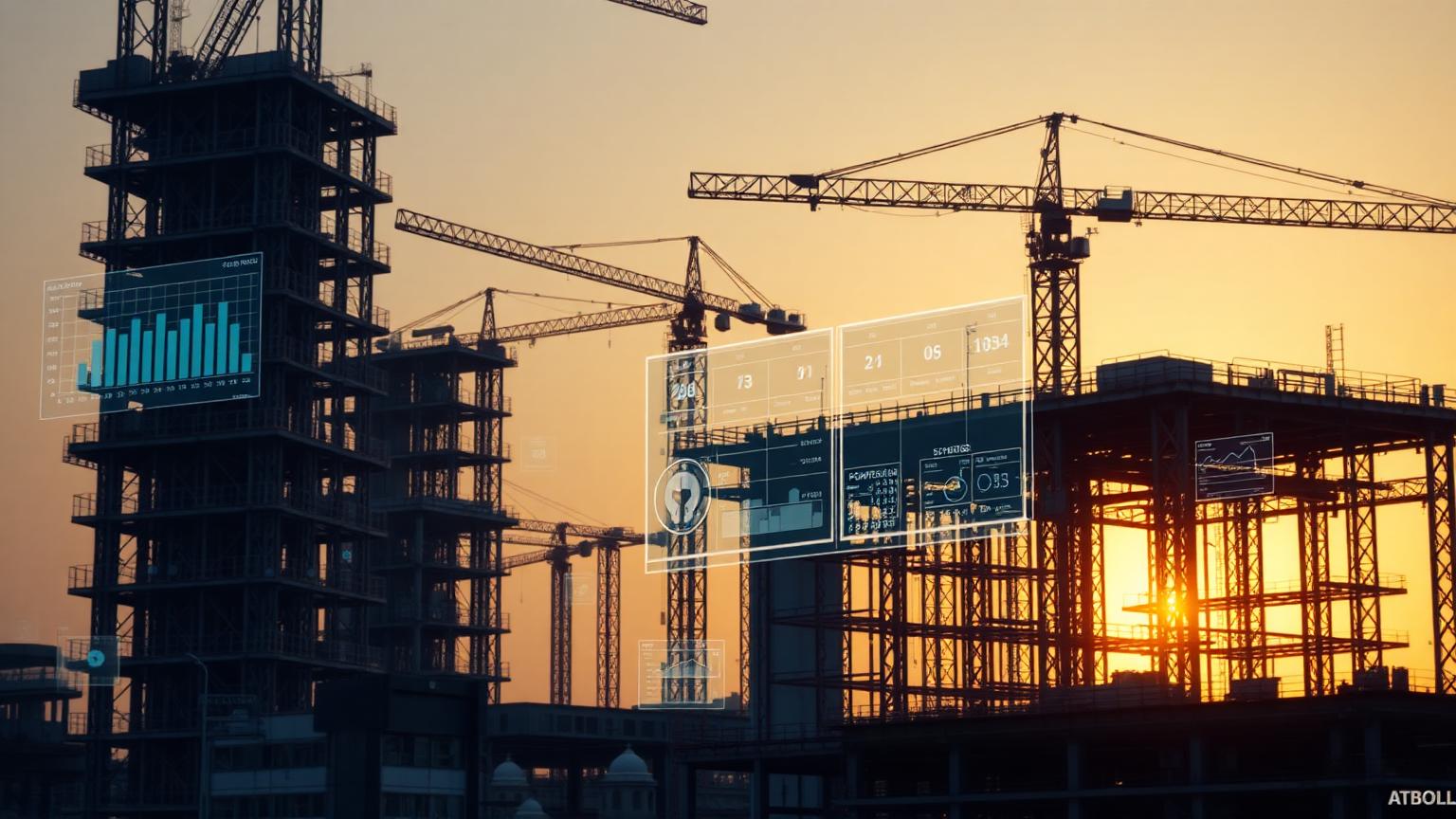
Construction has spent the last decade digitising its paperwork. BIM replaced 2D drawings, cloud platforms replaced shared drives, and mobile apps replaced the site diary. The next shift is different in kind, not just in degree: artificial intelligence is moving from a back-office reporting aid into a genuine decision-support layer across scheduling, cost, safety, and quality. Having run AI pilots across high-rise residential, commercial fit-out, and infrastructure projects, this article sets out where the advantages are real, why they show up, and what a project manager needs in place before expecting a return.
Why This Matters Now
Construction remains one of the least digitised major industries by productivity growth, and the reason is structural: every project is a one-off, every site has unique conditions, and the workforce is dispersed across dozens of subcontractors who rarely share a common data platform. AI changes the economics of that fragmentation. It does not need every party to adopt the same software — it needs enough structured and unstructured data (drawings, daily reports, schedules, photos, sensor feeds) to find patterns a human team would take weeks to surface manually.
The advantage of AI on a construction project is not that it makes decisions for you. It is that it compresses the time between a problem existing and a project manager knowing about it.
1. Predictive Scheduling and Delay Forecasting
Traditional CPM scheduling tells you what should happen if every assumption holds. AI-assisted scheduling tools go further: they ingest historical productivity data, weather patterns, subcontractor performance history, and current programme status to forecast where a schedule is statistically likely to slip — often weeks before the variance shows up in a conventional SPI calculation.
On a live programme, this looks like a model flagging that a particular trade's actual production rate on similar floor-by-floor work has consistently run 15% below the planned rate across the last six levels, and projecting the cumulative effect on the critical path if the trend continues. A planner reviewing the same data manually would need to pull six separate progress reports and do the arithmetic by hand — by which time the slip has often already compounded.
-
Earlier visibility of schedule risk, often 4–6 weeks ahead of a conventional SPI trigger.
-
Scenario modelling — instantly comparing the programme effect of resourcing options, sequencing changes, or weather contingencies.
-
Reduced reliance on a single planner's intuition for identifying which of hundreds of activities actually carries risk.
2. Cost Forecasting and Budget Control
AI-enhanced cost control does not replace EVM — it sharpens the inputs that EVM depends on. Machine learning models trained on historical cost data from comparable projects can flag cost line items that are trending away from their expected burn rate before the monthly cost report would catch them, and can cross-reference procurement commitments against market price movements for key materials such as steel, concrete, and copper.
The practical advantage is in the speed of detection. A quantity surveyor manually reconciling commitments against budget on a 40-package project might catch a material cost overrun at month-end. A model continuously comparing committed cost against forecast, updated daily as purchase orders and invoices land, can flag the same overrun within days — giving the commercial team time to act on it within the same reporting cycle rather than explaining it after the fact in the next one.
A CPI of 0.91 discovered on day three of a trend is a manageable conversation. The same CPI discovered at month-end, after the cost has compounded for four weeks, is a recovery plan.
3. Safety Monitoring and Risk Prediction
This is where the advantages of AI are most immediately visible to a site team, and where adoption resistance tends to fall away fastest once people see it working. Computer vision systems trained on site camera feeds can detect PPE non-compliance, unsafe proximity to mobile plant, and unauthorised entry into exclusion zones in real time — flagging incidents to site supervisors within seconds, not at the next walk-around.
Predictive safety models go a step further, correlating historical incident data with variables such as crew fatigue indicators (hours worked, shift patterns), weather conditions, and the specific combination of trades working in close proximity, to flag elevated-risk situations before an incident occurs rather than analysing root cause after one.
-
Real-time PPE and exclusion-zone compliance monitoring via existing site CCTV infrastructure.
-
Pattern recognition across near-miss reports that a manual review would likely miss — most safety teams do not have time to read every near-miss report across a 300-person site looking for recurring themes.
-
Predictive flagging of high-risk day/crew/activity combinations, allowing supervisors to target toolbox talks and inspections precisely rather than generically.
4. Document Intelligence and RFI Management
Every construction project generates a volume of documentation that exceeds any individual's capacity to track manually — drawings, specifications, RFIs, submittals, correspondence, and contract variations. AI document intelligence tools can compare drawing revisions automatically, flagging exactly what changed between Rev C and Rev D rather than requiring an engineer to spot the difference visually. They can also scan incoming RFIs against the existing specification and drawing set to flag whether the question has already been answered elsewhere in the contract documents — reducing the volume of duplicate or unnecessary RFIs reaching the design team.
On a project running a weekly automated drawing comparison, we reduced design-driven RFIs by roughly 30% simply by catching scope changes between revisions before they generated a query. The model did not replace the engineer's judgement on what to do about a change — it replaced the manual, error-prone process of noticing the change existed in the first place.
5. Quality Control and Defect Detection
Computer vision applied to quality inspection is maturing quickly. Models trained on thousands of images of correctly and incorrectly installed work — rebar spacing, weld quality, surface finishes, waterproofing membrane laps — can flag likely defects from a site photo before a human inspector physically walks the area. This does not replace the inspector; it prioritises where the inspector's time goes, and creates a contemporaneous photographic record that strengthens the defects register and reduces disputes over when an issue actually occurred.
The genuine advantage here is consistency. A fatigued inspector at the end of a long site walk applies a different level of scrutiny than the same inspector at 7am. A model applies the same threshold every time, which makes the defect detection process more defensible and repeatable — particularly valuable on projects with multiple QA/QC inspectors rotating through different zones.
6. Resource and Labour Optimisation
AI-driven workforce planning tools analyse historical productivity data by trade, crew, and activity type to recommend optimal crew sizes and sequencing — surfacing inefficiencies that are invisible in a standard resource-loaded schedule. A model might identify that a particular crew configuration consistently underperforms on confined-space work compared to open-floor work of the same scope, information a resource planner would rarely have the data density to detect manually across dozens of past projects.
This extends to subcontractor performance benchmarking: tracking actual delivery against committed look-aheads, productivity rates, and defect rates across packages, building an objective performance record that strengthens both day-to-day management conversations and future procurement decisions.
What You Need Before AI Pays Off
None of the advantages above are automatic. AI performs only as well as the data discipline underneath it, and construction's biggest barrier to AI adoption is not the technology — it is the quality and structure of the data feeding it.
Clean, Structured Source Data
A model trained on inconsistent daily reports, ad hoc photo naming, or a schedule with the missing logic and hardcoded constraints common to most CPM audits will produce confident, wrong outputs. Get the underlying project controls discipline right first — the WBS, the schedule logic, the cost coding structure — or the AI layer inherits every existing data quality problem and amplifies it.
A Human Decision-Maker in the Loop
Every credible AI deployment in project controls keeps a human making the final call. The model accelerates detection and surfaces patterns; the project manager, commercial manager, or safety officer still decides what to do about it. Treat AI output as a first draft or an early warning, never as a finished work product or an autonomous decision.
Realistic Scope — Start Narrow
The projects that get genuine value start with one well-defined use case — drawing comparison, or safety camera monitoring, or cost trend detection — run it for a full reporting cycle, and expand only once it has demonstrably paid back. Attempting to deploy AI across scheduling, cost, safety, and quality simultaneously on a single project, without first proving value in one area, is the most common way adoption stalls.
Data Privacy and Contractual Sensitivity
Construction data is commercially and sometimes legally sensitive — correspondence, claims positions, subcontractor performance data. Never feed contract-sensitive material into a public model with no data residency guarantees. Use an environment where your data stays inside your organisation's control, and keep a written log of what was AI-assisted versus human-authored, both for audit purposes and to build institutional knowledge of what is actually working.
The Honest Limits
AI does not yet replace judgement on contractual strategy, concurrent delay analysis, claims positioning, or the genuinely political dimensions of stakeholder management. Models trained on historical patterns struggle with the truly novel — the first-of-its-kind structural method, the unprecedented site condition, the relationship judgement call about whether to push a client or hold a position. Teams that have tried to push AI into these areas have quietly walked the deployment back. The advantage of AI in construction project management is real, but it is bounded: it removes drudgery and accelerates detection in domains with enough historical data to learn from. It does not remove the need for an experienced project manager making the calls that data alone cannot make.
Bringing It Together
The construction projects seeing genuine advantage from AI today share a common pattern: disciplined underlying project controls, a narrow and well-defined starting use case, a human decision-maker firmly in the loop, and patience to let the model prove value over a full reporting cycle before expanding scope. Used this way, AI does not replace the project manager's judgement — it gives that judgement better, earlier information to work with. On a discipline where the gap between knowing about a problem and a problem becoming unrecoverable is often measured in weeks, that earlier information is the entire advantage.
The construction projects that benefit most from AI are the ones with the best project controls discipline already in place. AI rewards rigour — it does not create it.
Construction project manager (PMP, MCIOB) with 20+ years on infrastructure, commercial and industrial builds across the GCC and NZ. Writes about the controls, contracts and field practices that actually move projects.
Read full bio →