How a PMO Earns Its Keep on a Construction Project
What a construction PMO actually delivers — the three PMI models, owner-side versus contractor-side, the eight things a good PMO does, why most fail, and five tests for whether yours is working.
Project names, parties and commercially sensitive figures referenced in this article have been anonymised or generalised. Examples reflect real situations encountered across multiple projects; they are not attributed to any specific client, contractor or contract.
Ask a project manager what the PMO does and you will get one of two answers.
The first: "They're the reason I spend Friday afternoons filling in a template nobody reads."
The second is rarer and more interesting: "They caught the cladding problem on Tower B three months before we would have, because they'd already seen it on Tower A."
Same function. Opposite verdicts. The difference is almost never the people — it is whether the PMO was set up to collect information or to change decisions.
This article sets out what a PMO actually is in PMI's terms, what it delivers specifically on construction work, why so many become reporting overhead, and how to tell within a quarter whether yours is earning its keep.
A note on the title: the original question was "how do I benefit from a PMO." That framing assumes the answer is yes. The more useful question is what a PMO has to do before it produces a benefit at all — because a badly set up one is a net cost, and plenty are.
What PMI Actually Says a PMO Is
The PMBOK® Guide defines a project management office as an organisational structure that standardises project-related governance processes and facilitates the sharing of resources, methodologies, tools and techniques.
Two words in that definition do the work: standardises and shares. A PMO is not a group of extra project managers. It is the mechanism by which several projects stop being run as unrelated one-offs.
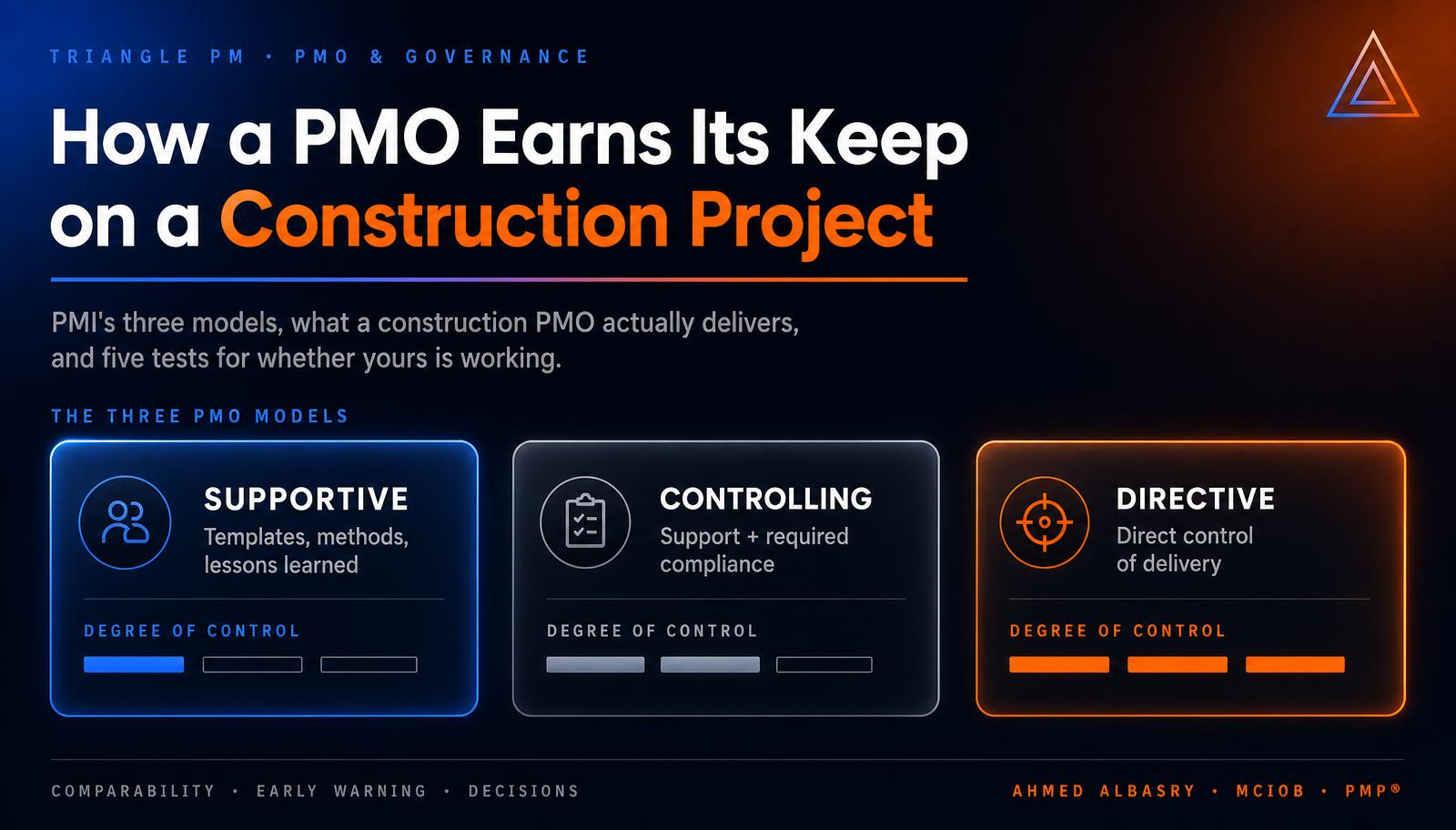
PMI describes three models, distinguished by how much control they exercise:
| Model | What it does | Degree of control | Best suited to |
|---|---|---|---|
| Supportive | Provides templates, methods, training, lessons learned. Consultative — a repository and a coach | Low | Mature delivery teams; loose portfolios; organisations building capability |
| Controlling | Provides support and requires compliance — frameworks, governance gates, mandated tooling | Moderate | Most construction portfolios; mixed team maturity; regulated or public work |
| Directive | Takes direct control. Project managers report into the PMO and are assigned by it | High | Programmes where consistency matters more than local autonomy; owner-side capital programmes |
The seventh edition of the PMBOK® Guide shifts the emphasis further — away from process compliance and toward the PMO as an enabler of value delivery. In practice that reads as a useful challenge: if your PMO can describe what it produces only in terms of documents collected, it is operating a version of the role that PMI itself has moved on from.
Most construction PMOs sit in the controlling band, and most of the ones that fail do so because they were sold as supportive and then behaved as directive — asking for compliance they had no mandate to enforce.
Why Construction PMOs Are Different
Most PMO literature was written for organisations where projects are internal change — IT, transformation, product. Construction inverts that. The projects are the business. They are the revenue, not an overhead on it.
Four consequences follow, and they change what a good construction PMO looks like:
The unit of failure is larger. A failed IT project wastes a budget. A failed construction project can consume a year of margin, trigger liquidated damages, and expose the balance sheet to a claim. The threshold for intervention should be lower.
The data already exists. Construction generates programmes, cost reports, valuations, site diaries and risk registers as a matter of course. A construction PMO rarely needs to create new reporting — it needs to make what exists comparable across projects. That is a much smaller ask than most PMOs make.
Delivery is contractual. IT projects can be re-scoped by agreement. Construction projects are bounded by a contract with notice periods, time bars and defined remedies. A PMO that ignores the contractual layer will produce governance that has no purchase on the actual risks.
Site does not stop for reporting. The single most reliable way to kill a construction PMO is to make it something the site team has to serve rather than something that serves them. If your monthly return takes a project engineer four hours, you are converting delivery time into administration and calling it governance.
The Eight Things a Construction PMO Actually Delivers
Not what it produces. What changes because it exists.
1. One reporting standard, so projects become comparable
Three projects reporting "70% complete" using three different measurement rules produce a portfolio number that means nothing. A PMO that does only one thing should do this: define how progress is measured, how cost is accrued, how a risk is scored, and then hold every project to it.
Comparability is what makes everything downstream possible. Without it there is no portfolio view — only a stack of unrelated reports in the same folder.
2. Baseline discipline and change control across the portfolio
Individual project teams under pressure re-baseline. It is understandable and it destroys the ability to see drift. A PMO owns the rule that baselines change only through approved change, and it owns the register that records every change against every project.
This is the least popular thing a PMO does and frequently the most valuable.
3. Portfolio-level early warning
A single project's CPI drifting from 0.98 to 0.95 is a conversation. The same drift appearing on four projects in the same quarter is a systemic problem — a rate that was set too low at tender, a subcontractor market that has moved, a design partner that has slipped.
No project manager can see that pattern from inside one project. It is structurally invisible without an aggregating function. This is the clearest single argument for a PMO existing at all.
4. Resource and capacity management
Which projects need a senior planner in March? Can we win that tender given who is already committed? Which team is carrying three jobs in defects while starting a fourth?
Capacity questions cannot be answered from within a project, and answering them badly is how organisations end up with a stretched good contractor's problem — internally.
5. Assurance and stage gates that mean something
A stage gate is only worth holding if it can stop something. A PMO that runs gates with no authority to withhold approval is running a meeting, not a gate.
The useful version is narrow: two or three genuine hold points across the lifecycle — baseline acceptance, procurement strategy sign-off, readiness for handover — each with defined evidence and a named approver.
6. Lessons that actually travel
Every project runs a lessons-learned session. Almost none of those lessons reach the next project, because they are captured as documents rather than as changes to the standard.
A PMO closes that loop structurally: a lesson is only closed when it has changed a template, a checklist, a gate criterion or a standard clause. Anything else is a filed document.
7. Procurement and commercial consistency
Standard prequalification questions. A consistent tender evaluation model. Bond and insurance requirements that don't get reinvented per project. A register of which subcontractors performed and which did not, that survives the departure of the PM who knew.
8. Aggregated risk
Individual registers miss correlated risk. Four projects each carrying a modest exposure to the same supplier, the same consenting authority or the same specialist trade is a concentration that only appears when the registers are read together.
What That Looks Like in Practice
An abstract list of benefits is easy to nod at and hard to act on. Here is the same argument as a sequence of events.
A residential developer is building four towers on one site under separate contracts, staggered roughly four months apart. Each has its own project manager, its own cost report, its own risk register. All four report monthly to the same board.
Month 8. Tower A's façade package is running late. The project manager reports it as a supplier issue, notes recovery actions, and moves on. Read in isolation it is unremarkable — one package, one supplier, one month.
Month 9. The PMO's portfolio view shows something the individual reports do not. Tower A's façade is late. Tower B's façade procurement, four months behind, is showing the same supplier and the same lead time assumption in its cost plan. Towers C and D have the same assumption sitting in their tender documents, unissued.
That is not four project problems. It is one procurement assumption, replicated four times, of which only the first has surfaced.
What changes. Because the pattern is visible at month 9 rather than month 20, three things become possible that would not have been available later: Tower B's package is retendered before commitment; C and D's tender documents are amended before issue; and the developer opens a conversation with the supplier from a position of a four-tower order book rather than one late package.
What it cost to see it. Not a system. Three fields reported identically across four projects — package, supplier, lead time — and one person reading the four reports side by side rather than sequentially.
That is the mechanism in full. No project manager could have seen it, because each of them could only see their own tower. It was structurally invisible from inside a project, and obvious from above.
The counterfactual matters too. Without that view, Tower B commits, C and D issue, and the developer discovers the same problem three more times at full price — each time as a fresh crisis, each time investigated from scratch.
Owner-Side, Contractor-Side, Consultant PMO
These are three different jobs and conflating them is a common source of disappointment.
| Owner / client PMO | Contractor PMO | Consultant PMO | |
|---|---|---|---|
| Primary question | Are we getting the assets we're paying for? | Are we delivering profitably and repeatably? | Is the client's delivery being independently assured? |
| Core focus | Business case, funding, benefit realisation, stage gates | Margin, cash flow, resource capacity, bid-to-delivery handover | Governance, assurance, reporting, independent review |
| Owns | Scope, budget, approvals, benefits | Delivery method, resourcing, commercial performance | Process and evidence, not outcomes |
| Typical failure | Becomes an approval bottleneck | Becomes head-office reporting the site resents | Produces reports with no authority behind them |
If you're commissioning a PMO, name which of these you're building. Most disappointing PMOs were sold as one and staffed as another.
Five Tests: Is Yours Working?
You can assess this in a quarter. None of these require a maturity model.
1. Can it answer a portfolio question in under an hour? "Which of our projects are forecasting an overrun above 3%, and what's driving each one?" If that takes a week of chasing project managers, the PMO is collecting data rather than holding it.
2. Has a decision changed because of something the PMO surfaced? Name one, from the last quarter. A resequenced procurement, a reallocated planner, an intervention on a drifting project. If nothing comes to mind, the reporting is descriptive rather than decision-driving.
3. Do project managers use the templates when nobody is checking? The honest signal. Teams comply with what is enforced and adopt what is useful. Adoption without enforcement means the tool is genuinely better than what they'd otherwise build.
4. Has a lesson from one project measurably changed another? Not "was captured" — changed. A revised gate criterion, an amended standard clause, a different prequalification question.
5. Is the reporting burden falling? A maturing PMO should reduce total effort over time as templates stabilise and data flows automate. If the monthly return is getting longer each year, the PMO is growing rather than improving.
What to Measure — and What Not To
Most PMO scorecards measure the PMO's own activity. That is the easiest thing to count and the least useful thing to know.
| Measure this | Not this |
|---|---|
| Decisions changed by portfolio reporting, per quarter | Reports issued on time |
| Issues caught on project N because they occurred on project N−1 | Lessons-learned sessions held |
| Hours the site team spends on portfolio reporting — falling | Template library size |
| Variance between forecast and outturn, narrowing over time | Forecast accuracy at a single point |
| Voluntary template adoption where not mandated | Compliance rate under mandate |
| Time to answer an unplanned portfolio question | Dashboard refresh frequency |
The right-hand column is easy to improve and improving it changes nothing. The left-hand column is harder to instrument and is the only evidence that the function is working.
One practical suggestion: keep a decision log. One line per portfolio-level decision the PMO's reporting drove, with the date and the outcome. Four entries a quarter is a healthy PMO. Zero entries over two quarters is a reporting function, whatever it's called — and that is worth knowing before someone else works it out at budget time.
Why PMOs Fail
| Failure mode | What it looks like | The fix |
|---|---|---|
| Reporting without decisions | Beautiful dashboards; nothing changes | Every report ends in actions with owners and dates |
| Authority mismatch | Asked to enforce standards it has no mandate to enforce | Name the model — supportive, controlling, directive — and give it the matching authority |
| Duplicating the project manager | PMO staff doing work the PM already does | The PMO's unit of work is the portfolio; anything project-level belongs to the project |
| Standards nobody asked for | Templates written in isolation, adopted by nobody | Co-design the standard with two project teams first |
| Measuring compliance, not outcomes | KPIs about returns submitted on time | Measure decisions influenced and problems caught early |
| Growing headcount before value | The PMO expands before it has proven anything | Start with one person and one comparable report; earn the second |
| No route to the board | Findings stop at the project directors | The escalation path must reach someone who can fund a change |
| Ignoring the contractual layer | Governance that never touches notices, variations or claims | Integrate the contract administration registers into the portfolio view |
The meta-failure sits underneath all of them: treating the PMO as an assurance function rather than a delivery one. Assurance describes what happened. Delivery changes what happens next. Only one of those justifies its cost.
Setting One Up: The First 90 Days
Resist building the framework first. Build the smallest thing that produces a portfolio decision, then extend.
Days 1–30 — establish comparability. Pick the three numbers that matter across every project: forecast final cost against budget, forecast completion against baseline, and top three risks with an owner and a date. Define exactly how each is calculated. Get every project reporting them the same way. Nothing else.
Days 31–60 — produce the first portfolio view and act on it. One page, all projects, those three numbers with a trend arrow. Take it to the leadership meeting and drive one decision from it. That decision is the PMO's business case; nothing you write will be as persuasive.
Days 61–90 — standardise what was already being reinvented. Now, and only now, look at templates. Start where teams are visibly duplicating effort — monthly reports, risk registers, change control. Co-design each with two project teams so adoption is voluntary before it is required.
Then keep going in that order: comparability, decision, standard. A PMO that starts with the standard usually never reaches the decision.
Do You Actually Need One?
Honest answer: not always.
A single project, however large, does not need a PMO. It needs a good project manager and competent project controls. Adding a governance layer above one project creates a reporting relationship, not a portfolio view — and the whole value proposition above depends on comparison across projects.
The case strengthens when you have:
- Three or more concurrent projects sharing resources, systems or supply chain
- Repeat project types where a lesson from one genuinely applies to the next
- A leadership team that cannot answer portfolio questions without a round of phone calls
- Recurring failures of the same kind — the same variation argument, the same procurement slip, the same handover scramble
That last one is the strongest signal. Repeated failures of the same type are precisely what a PMO exists to eliminate — and if nothing in your organisation is currently eliminating them, you have your business case already written.
If none of those apply, invest in project controls capability inside the projects instead. The discipline matters more than the department.
Conclusion: The PMO's Job Is Making the Second Project Easier Than the First
Strip away the governance language and a PMO does one thing: it stops an organisation solving the same problem repeatedly at full cost.
Every project team learns something expensive. The question is whether that knowledge leaves with the team at handover, or whether it becomes a template, a gate criterion, a standard clause, a prequalification question — something the next team inherits without having to pay for it again.
That is the whole benefit, and it is why the tests above are about change rather than compliance. A PMO that collects perfect information and alters nothing has cost you the collection effort and returned nothing.
Start with three comparable numbers. Drive one decision from them. Standardise what was already being reinvented. Then let the scope of the function follow the evidence that it works — not the other way around.
Take It Further with Triangle PM
If you want to put this into practice, Triangle PM has the tools ready to go:
- PMO Templates — governance frameworks, portfolio dashboards, reporting cadence and steering pack templates.
- Project Controls Templates — EVM tracker, cost control log, schedule baseline workbook and the integrated reporting cadence a portfolio view depends on.
- Why Earned Value Management Matters — the measurement discipline behind any credible portfolio number.
- Full Library Bundle — all 31 production templates across 16 disciplines, FIDIC and NZS 3910 aligned.
👉 Explore the Triangle PM resource library and start with three numbers your whole portfolio reports the same way.
Ahmed Albasry is a Senior Building Surveyor and Construction Project Manager with 20+ years across residential, commercial and infrastructure projects, and the creator of the Construction Management Excellence Framework. PMBOK® and PMI® are registered marks of the Project Management Institute, Inc. PMO models referenced follow PMI's published framework; application to any specific organisation should account for its own portfolio, contracts and delivery model.
Construction project manager (PMP, MCIOB) with 20+ years on infrastructure, commercial and industrial builds across the GCC and NZ. Writes about the controls, contracts and field practices that actually move projects.
Read full bio →